Subterranean termites require continuous ground contact and ambient moisture to survive, building exterior mud shelter tubes across concrete beam foundations throughout Dallas County to penetrate framing timbers. In…
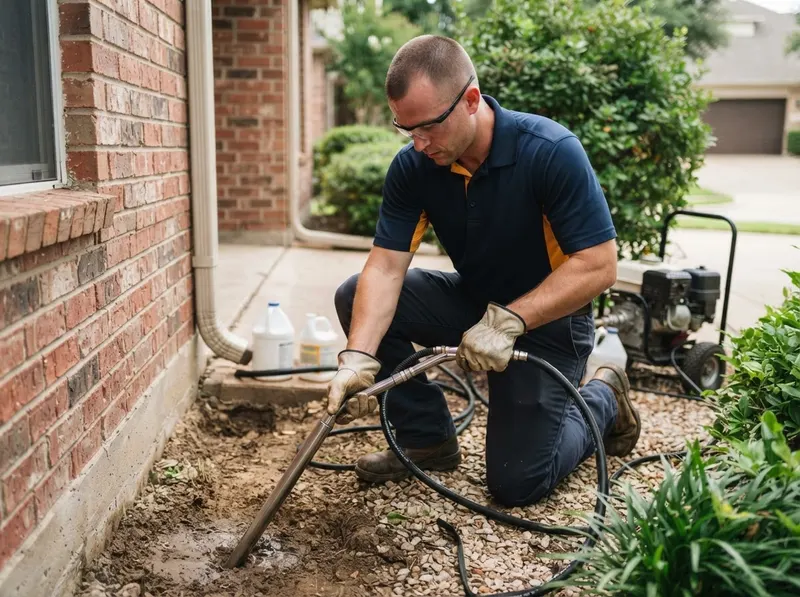
Subterranean termites require continuous ground contact and ambient moisture to survive, building exterior mud shelter tubes across concrete beam foundations throughout Dallas County to penetrate framing timbers. In North Dallas and Preston Hollow, extensive monolithic slab foundations often settle against shifting clay soils, creating hairline expansion fractures where foraging subterranean workers enter living spaces undetected. Perimeter trenching down 6 inches into the soil creates a continuous chemical boundary. Non-repellent liquid formulations bind to the soil particles; foraging worker termites pass through the zone without avoidance, carrying the active toxicant back into the central nest to collapse the reproductive queen and the entire subterranean colony through social grooming.
Pier-and-beam architecture common in Lakewood, East Dallas, and Kessler Park requires specialized crawlspace protocol. Moisture accumulation beneath these older subfloors accelerates structural cellulose consumption. Technicians trench around every interior support pier, rod the soil adjacent to grade-beam footings, and treat critical plumbing penetrations where subterranean leads emerge. When concrete walkways or patio slabs abut exterior walls in Lake Highlands or Oak Cliff homes, technicians drill 0.5-inch holes spaced roughly 12 inches apart through the flatwork to inject the liquid barrier directly into the concealed soil below, sealing each core hole with structural-grade mortar afterward.
Remediation protocols differ strictly between chemical liquid perimeter barriers and localized structural spot treatments. Localized foaming into interior drywall voids kills only the active foragers within that specific wall bay; it does not protect adjacent structural timber or eliminate the underground subterranean colony. A continuous liquid perimeter barrier provides comprehensive structural defense but requires continuous soil contact around the entire exterior footprint. For homes with extensive flagstone or sensitive hardscaping around the foundation, hexaflumuron or noviflumuron bait stations placed every 10 to 15 feet around the perimeter serve as an alternative method, though bait stations depend on natural termite foraging timelines of 60 to 90 days rather than the immediate barrier cutoff achieved by liquid termiticides.
Every job gets a firm, written price after a free on-site visit.
Tell us about your subterranean termite remediation job in Dallas and we'll send a clear, written quote, usually the same day.
 Black Anchor Pest Control